

[ad_1]
For all its exclusivity, fashion doesn’t exist in a vacuum—it reflects the culture, mood and real-world tensions of the moment, translating them into sartorial form. Throughout history, shifts in the wider cultural climate have found expression in what we wear: economic downturns have sparked trends rooted in restraint and practicality; darker periods have gone hand-in-hand with sombre palettes, while the ‘naked dressing’ boom has unfolded alongside a social media age defined by heightened visibility, performance and the relentless pursuit of perfection. There’s even a so-called ‘Hemline Index’ theory, which suggests skirt lengths rise and fall directly in line with the economy…
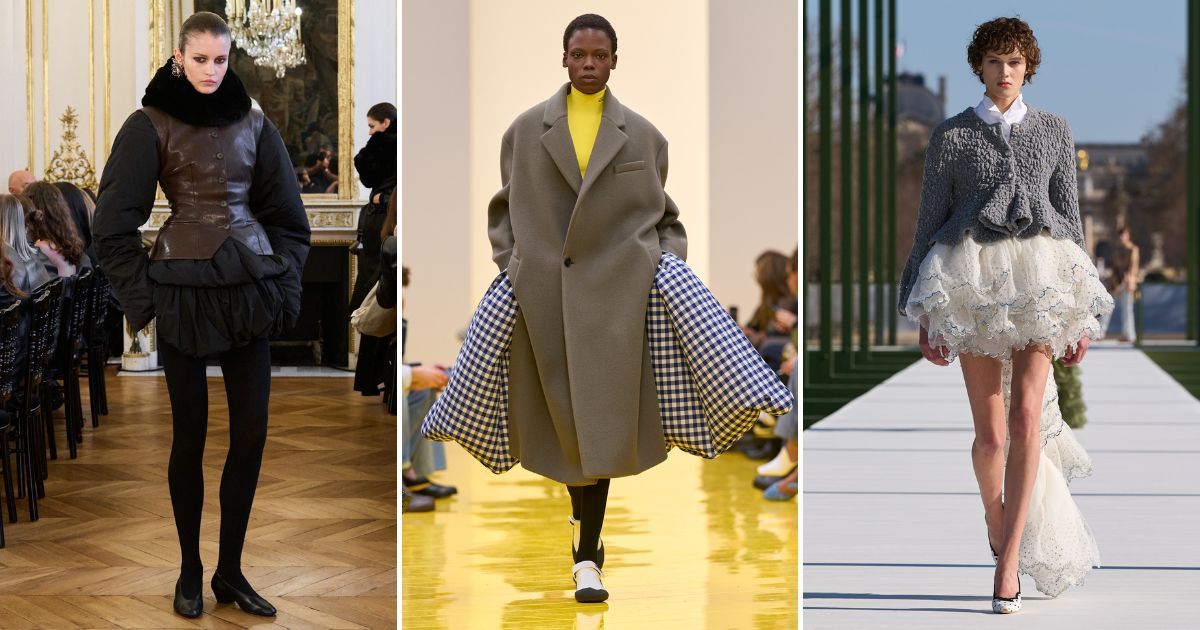
Which is perhaps why, as I sat front row through the recent Autumn/Winter 2026 season of shows, I found myself increasingly struck by the number of padded, sculptural silhouettes emerging on the runway—at the very moment bodies in the real world appear to be moving in the opposite direction.

(Image credit: Launchmetrics/Spotlight)
It’s hard to imagine that the timing is mere coincidence. Over the past few years, the inexorable rise of GLP-1 weight-loss medications such as Ozempic has transformed not only the medical landscape, but the wider cultural conversation around the female body itself. For many, of course, these drugs have been genuinely—and positively—life-changing. Yet their rapid dissemination and normalisation has also coincided with a perceptible shift in aesthetic ideals: namely, that thin is once again ‘in’, and visibly at the forefront of celebrity, fashion and popular culture alike.
Article continues below
Arguably, the fashion industry has always favoured smaller silhouettes, and any recent strides in the size inclusivity movement have felt more tentative than transformative—even performative, at times. This season, however, the relative absence of mid- and plus-size bodies on the runways felt impossible to ignore. Instead, in their place: traditionally thin models in clothes constructed specifically to create artificial curves and physically larger forms.

Richard Quinn, McQueen, Simone Rocha AW26
(Image credit: Launchmetrics/Spotlight)
See: the padded-out skirts and tops at Magda Butrym, inflatable outerwear at Loewe, dramatic layered ruffles at Dior, sculpted, puffed-up and voluminously embellished coats at Bottega Veneta, boned hourglass gowns at Richard Quinn, the sculpted hips skirt at McQueen, Simone Rocha’s bulbous crinolines, as well as the prominence of peplums everywhere from Givenchy and Mugler to Patrick McDowell.
Rather than signalling a genuine shift in body ideals, however, the season’s shapely silhouettes seem to expose a more uncomfortable truth: that while thinness is once again being actively pursued—and increasingly normalised—traditional notions of feminine shape and the concept of ‘taking up space’ remain aesthetically valuable, just not when they exist naturally.

(Image credit: Launchmetrics/Spotlight)
Instead, curves and physical volume are becoming something that can be switched on and off; bought, styled and removed at will. “It seems to me that what’s being sold isn’t really the notion of curves, but an interchangeable body shape,” says author and Fashion’s Digest UK contributor Stephanie Yeboah. “There’s clearly an undercurrent of nostalgia for curves, but instead of rejecting thinness outright, [the industry is] keeping thinness as a base and reintroducing curves as decoration.”
“As someone who lives in a bigger body, this ‘trend’ is frustrating to watch play out,” continues Yeboah. “Because even though the look of my body is desirable, the lived reality of my body isn’t fully accepted on runways or in sizing. Fashion wants the idea of my body—just not my actual body. It feels like curves are being aestheticised at the exact moment they’re being erased, which is a contradiction in and of itself. Fashion is still trying to have it both ways, selling the fantasy of femininity and shape while maintaining the industry’s preference for thinness.”
And on top of this, it’s giving capitalism at its most extreme, in which both the perceived ‘problem’ and its ‘solution’ are endlessly monetised. For now, at least, fashion seems content to only create the illusion of curves—without making space for the bodies that actually have them. Here’s hoping the scales soon tip in the other direction.
TOPICS
[ad_2]
Source link