

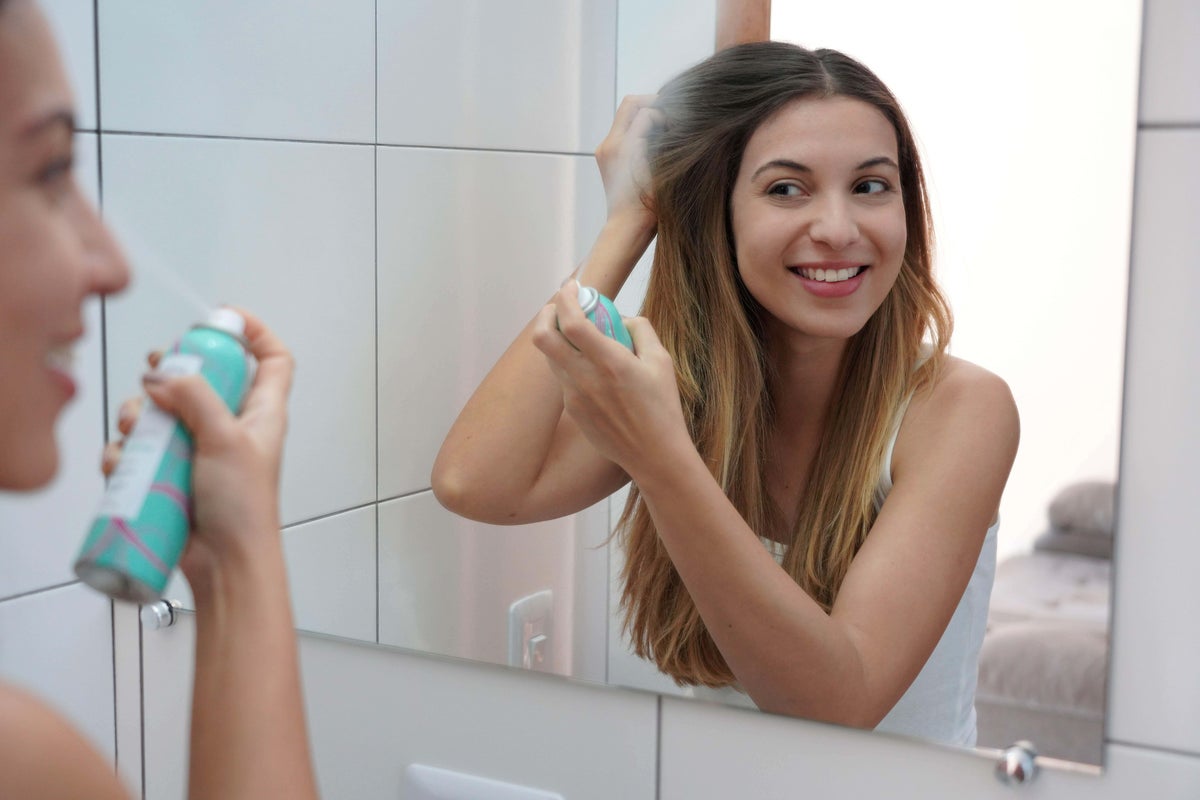
While many of us may have our hair-washing schedules down to a T, sometimes life gets in the way, and dry shampoo is the next best thing.
But while using it seems relatively straightforward, the technique of how to apply it, how much and how often is very particular when it comes to our scalp health.
According to lead trichologist and brand president at Philip Kingsley, Anabel Kingsley, dry shampoo should be seen as a temporary fix, not a replacement for proper cleansing.
“Unlike real shampoo, which is rinsed away with water, dry shampoo does not remove skin secretions, dead skin cells, dirt and product debris.
“A day or two of using a dry shampoo is fine, but any longer without a ‘real shampoo’ is likely to result in an itchy and irritated scalp,” she explains.
So, here’s everything you need to know about using dry shampoo to keep you hair in tip-top condition.
It builds up on the scalp
The biggest issue with dry shampoo is that it doesn’t actually clean your hair, but gives the illusion of clean hair by absorbing excess oil at the root.
Over time, this leads to a build-up of product, sweat and dead skin cells sitting on the scalp. “Using dry shampoo too often will cause product build-up,” Kingsley says, which can leave the scalp feeling congested rather than refreshed.
This build-up doesn’t just affect how your hair looks but it can also disrupt the scalp’s natural microbiome, which protects the skin barrier on your head and is essential for healthy hair growth.
Living Proof Clarifying Detox Shampoo, £32
Act+Acre Cold Processed Scalp Detox, £46, Cult Beauty
It can trigger irritation and itchiness
If you’ve ever noticed your scalp feeling itchy after a few consecutive days of dry shampoo, there’s a reason for it.
“Any longer without a real shampoo is likely to result in an itchy and irritated scalp,” explains Kingsley, who says the combination of trapped oil, sweat and product residue can aggravate the skin, particularly if you’re already prone to sensitivity.
In some cases, this can also lead to visible flaking or dandruff-like symptoms – something many people mistakenly try to “fix” with even more dry shampoo.
Philip Kingsley Flaky/Itchy Anti-Dandruff Scalp Toner, £26
It may impact hair quality over time
While dry shampoo doesn’t directly cause hair loss, an unhealthy scalp environment can have knock-on effects.
“Irritated and itchy scalps can inhibit hair growth and cause hair to become brittle, leading to increased shedding,” says Kingsley.
In other words, it’s not the product itself that’s the problem but the condition it creates when overused.
A congested, inflamed scalp – which can lead to dysbiosis, where harmful microorganisms outnumber beneficial ones – is far from an ideal environment for strong, healthy hair growth.
You might notice visible warning signs
Overuse doesn’t always creep up unnoticed, and there are some tell-tale signs your routine needs a reset.
“Visible white residue, dandruff or flaking, itchiness, irritation or redness and even dullness of the hair strands” can all indicate you’re relying on dry shampoo too often, Kingsley says.
Hair can also start to feel heavier at the root but drier through the lengths – a sign that oil is being absorbed without the rest of the hair being properly cleansed or conditioned.
How often should you really be using it?
The good news is you don’t need to ditch dry shampoo entirely – you just need to use it carefully.
“If you do not have time to wash your hair then using a dry shampoo for one to two days is fine,” Kingsley advises. It can also double as a styling product, with “a few spritzes on the crown” helping to add volume to limp strands.
However, she stresses that it should never replace washing altogether. Ideally, you should leave no more than two days between proper shampoos.
“Our scalp is an extension of the skin on our forehead,” she explains, “if your scalp is not clean and healthy, it simply will not produce hairs of beautiful, strong quality.”
K18 Biomimetic Hairscience AirWash Dry Shampoo, £48, Cult Beauty
How to use dry shampoo properly
To minimise damage, application technique matters just as much as frequency.
Dry shampoo should always be focused on the roots – not sprayed through the lengths – as this is where oil accumulates. Those with naturally oilier hair tend to see the best results, as the product works by absorbing excess sebum.
If you’ve been relying on it for a few days, Kingsley recommends following up with a more thorough cleanse.
“For infrequent hair washers, I recommend double cleansing and using a weekly exfoliating scalp mask,” she says, “this helps remove build-up from products and pollution.”
Incorporating a scalp toner can also help rebalance the skin, particularly if irritation has already set in.
Ultimately, “dry shampoos should not be used as a regular replacement for real shampoo,” Kingsley blankly puts it. Because when it comes to healthy hair, it all starts at the scalp – and sometimes, nothing beats a proper wash.
Kérastase Symbiose Micro-Exfoliating Cellular Treatment, £37.50, Look Fantastic