

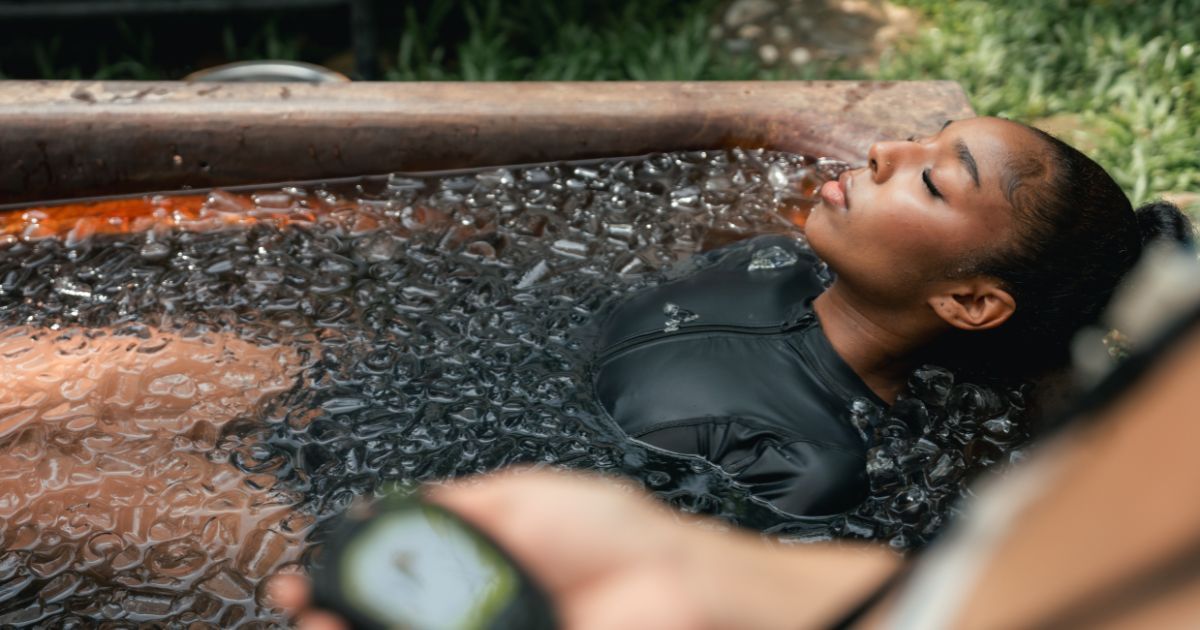
Spoiler, readers: I love a cold plunge. Because when it comes to dipping my toe into the world of wellness, I’m no stranger – even when that toe is about to meet ice-cold water. This January is no different, despite the dark mornings and cold temperatures. But as I got my bikini and towel ready last week and saw minus temperatures on my phone weather app, I started wondering to myself… is my weekly cold plunge actually good for me, or would staying wrapped up in the warmth have done me more good?
Industry reports show that cold-water exposure searches have surged more than 900% in just five years, so it’s no surprise that it’s being sold as a “must-have” for the new year and a fast track to more energy, mental clarity, and emotional resilience.
You only need to scroll through TikTok, or Google “January reset”, and it’s there – framed as both a badge of honour and a shortcut to becoming your best self, delivering one simple message: endure the cold, reap the rewards.
What once felt extreme is now aspirational. Every week, I drag my body to the sauna, and right at the end, I convince myself that a minute in the cold plunge will set me up for the week ahead. A necessary stress-proof that I’m doing wellness “properly.”
That all changed when I watched a video by Dr Stacy Sims, who suggested that cold plunging may actually be stressing women more than we realise, especially during winter. Digging deeper, one statistic literally stopped me in my tracks: research from a 2021 Sports Medicine paper found that 70% of exercise science research has historically been conducted on men. So most of the cited benefits of cold water therapy are based on male hormones, male stress responses, and male recovery patterns.
Which led me back to the question of whether cold plunging is actually good for women. The research seems to be pretty divided, so I’ve asked top experts to share their thoughts, below. Don’t miss our guides to whether cold water is bad for you, the benefits of ice baths, and the Wim Hof Method, while you’re at it.
The science on cold plunging for women is divided – here, top experts weigh in
What happens to your body during a cold plunge?
Raise your hand if you’ve ever assumed that the initial shock of a cold plunge is just your body being dramatic, or a flaw in your resilience? Yep, me too. But the science says otherwise: studies show cold water exposure activates the sympathetic nervous system, spiking your adrenaline and cortisol.
That fight-or-flight feeling you get while begrudgingly counting down the seconds in a plunge pool? That’s your survival instinct kicking in, as Anna Estop-Hall, Women’s Hormone Health Nutritional Therapist, explains, “The body doesn’t experience it as a relaxing, at first – it initially registers it as a shock. Breathing becomes rapid, the heart rate increases, and the nervous system moves into a state of alert,” she explains.
While that’s the moment most of us are told to “push through”, it’s what happens after the shock that matters. “If the body has enough capacity to recover, this shift can feel supportive. But if someone is already feeling exhausted, under significant stress, or running on poor sleep, that initial shock doesn’t always soften into calm. It can leave the system feeling more on edge.”
Is cold plunging really good for women?
This is the fine print that the cold-plunge hype often skips. Research proves that women don’t process recovery or stress in the same way men do, and so that icy shock can become a stressor, rather than an awakening. How your body responds depends on your hormones, sleep, workload, training, and even the season.
The real kicker? Women’s bodies are massively under-researched, so figuring out if cold plunging is actually right for us means looking through multiple lenses: hormones, stress load, recovery, and yes, a bit of trial, error, and grit.
Angela Foster, a Health and Performance Coach, warns, “For women, very cold, prolonged, or frequent plunges should be approached with caution. Done too often or for too long by women already carrying high stress, can spike cortisol, suppress thyroid function, and worsen fatigue – especially if you’re under-fuelled, over-trained, or chronically stressed.”
And, spoiler: winter can add to the stress load, too. By January, our reserves are already low: less sunlight, disrupted sleep, and elevated stress take their toll. And when the body is depleted, further research conducted by the Institute of Medicine (US) Committee on Military Nutrition Research found that adding repeated cold exposure can sometimes ask too much of the body.
As acupuncturist and founder of Yin-Space, Madalaine McCarthy, explains, “Seasonality matters. Women generally have lower muscle mass and different fat distribution than men, which reduces the heat your body naturally generates. In winter, repeated cold exposure can place extra demand on your metabolic and hormonal systems to maintain warmth, which can worsen fatigue, disrupt sleep, and amplify any stress-related symptoms.”
TLDR? In a season where many women are already stretched, cold plunging can tip from resilience-building to resource-draining.
And here’s the research reality: “Unfortunately, there are big gaps in female-specific studies, partly because women have historically been seen as harder to study due to hormones, pregnancy, and life stages. But with wearables and cycle data, that’s changing. Absence of evidence isn’t proof it’s safe; just because no one asked doesn’t mean the answer is yes. Assess interventions based on risk and your own data. Cold plunging can be low-risk if you listen to your body and track your health,” explains female longevity specialist Dr Kayla Barnes-Lentz.
Until women’s bodies are properly researched, nuance matters. Cold plunging can be supportive – but only when approached through the lens of your personal biology, hormones, stress load, and time of year. It’s not a universal “fix”.
Should women cold plunge? What the experts recommend
Taking stress and real life into account, one thing is clear: the most important data isn’t the temperature, it’s you. Shifting the question from if to when.
McCarthy explains, “I wouldn’t recommend cold plunges for anyone struggling with fertility issues, PCOS, endometriosis, anxiety, sleep problems, or dysregulated cycles – adding stress can make these worse.” She adds, “Plus, studies show repeated exposure can add extra demand on hormonal and metabolic systems.”
Dr Barnes-Lentz agrees that women don’t need extremes to see benefits. “Again, research has found that even a mild cold, around 16°C, can be effective.” If you’re new, try this: start warmer and work your way down, paying attention to how your body responds, she recommends.
She also highlights the importance of paying close attention to the signals your body sends, “Before deciding to cold plunge, women should ask themselves what level their current stress is. During times of higher stress, I dial back my cold therapy, and during lower stress seasons I dial it up.”
If you do decide to cold plunge, tune in to the little signals your body sends after: feeling jittery, struggling to sleep, craving sugar, hitting energy slumps, or noticing cycle changes. These aren’t signs you’re weak, according to Anna. “They’re your body waving a red flag.”
Shop MC’S rest and recovery essentials:
DIOME Rested Sleep Supplements
Optimising your sleep may just be one of the smartest things you can do in January to support recovery. As the focus turns to rest and reset, look no further than DIOME’s Rested sleep supplements, designed to support sleep quality and maintenance – helping you wake feeling more refreshed.

When recovery is the goal, your sleep setup really matters. Slip’s silk pillowcase is a luxurious yet practical essential that offers a smoother, more breathable surface, helping support a more comfortable night’s sleep.

Sometimes, feeling more rested begins with your surroundings. A candle transforms your space into a sanctuary, and the Baies candle from Diptyque encourages calm and relaxation as part of your nightly wind-down.
How can I boost my wellness this winter, if cold plunges aren’t for me?
January has a funny way of convincing us that the cure for winter fatigue: do more. More discipline, more intensity, more “hard things.” Cold plunges, HIIT classes, 5 am alarms – all framed as the price of productivity. The message is crystal clear: if you’re tired, you’re not trying hard enough.
But for women, that mindset often backfires, especially in winter.
As longevity specialist Dr Barnes-Lentz explains, “I’m not a fan of stacking multiple ‘good’ stressors on top of each other. All of these practices offer benefits, but the real question is always: is this the right intervention for me, and is this the right time?” And McCarthy adds, “recovery is the practice in winter. Listening to your body and allowing warmth, rest, and gentle support is what builds the resilience you’re seeking.”
Here’s what rarely gets said: cold plunges, HIIT, extreme routines – they’re all stressors (albeit good ones). And while stress can be adaptive in the right way, piling multiple intensity-based practices on top of an already full life, in a season that’s a huge stressor already, can quietly tip the body into depletion.
With research on women’s responses to cold plunges still limited, the most powerful tool we have is knowledge: tuning into our bodies and choosing what supports rather than stresses them. Until science catches up, education and self-care are our best guides. Perhaps the most radical thing women can do this winter is listen, not push.
Elsewhere on the site, we’ve got explainers on how to avoid the winter slump and how to boost your calm. For those already feeling exhausted, here’s your ultimate winter reset checklist to set you up for the season ahead.