

The leaves on the trees aren’t the only things sprouting this spring. We’ve unearthed an exceptional crop of new fiction – from revenge dramas and body horror, to a high-concept tale of an illicit love affair and a trip through an Andean music festival – that’s set to breathe new life into your reading list. And for all you aspiring writers out there, there’s also a ‘reverse engineering book’ featuring short stories by some truly exceptional writers, which are then disassembled by their authors to offer insight into how they work and write. Leaving just one question: which one will you break the spine of first?
Editor’s Picks
Marissa was living in southern Thailand with her father, a marine biologist, when the boxing day tsunami hit in 2004. With her best friend Arielle among the many missing and presumed dead, she has spent the past decade trying to escape the shadows of her past, moving back to her childhood home, New York, where she drifts through her days working for an online travel magazine and sleeping with strangers. But as the city begins to go into shutdown for Hurricane Sandy, the memories of that fatal Christmas loom ever nearer. Menon draws an extraordinary portrait of grief – for those lost in the disaster; for the death of her mother when she was a child; and for natural world. Her descriptions of the infinite, complex beauty of life beneath the waves and the ocean’s fragile ecosystem crash brutally against the horrors of the days and weeks following the tsunami, and Marissa’s own fragile hold on her sense of self and purpose since underscore both. A deftly told and wonderfully heartfelt debut.

Permanence, Sophie Mackintosh
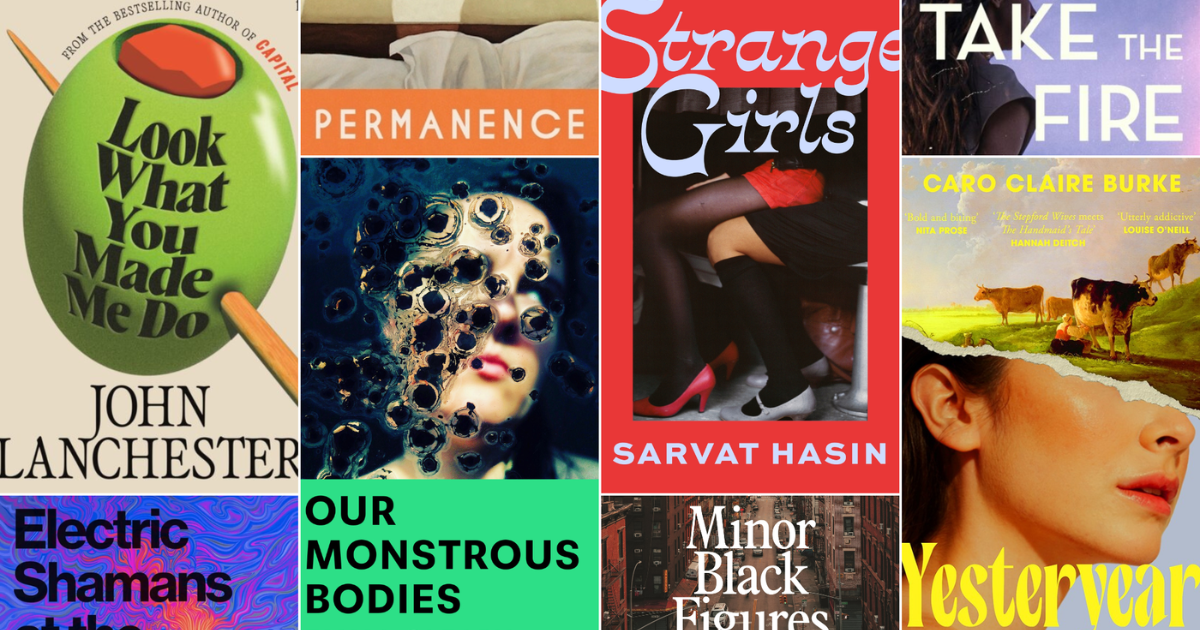
Mackintosh gives good high-concept. She’s done it before with young women being allotted the right to give birth or otherwise in Blue Ticket, and in her depiction of a French town given over to madness in in 2023’s Cursed Bread. Here, it’s the land for illicit lovers in which we first meet gallery worker Clara and married art historian Francis. The pair have been surviving on snatched hours together since beginning their affair some months before. On this day, however, they wake up together in a beautiful apartment in an unknown city populated solely by couples. Before long, it becomes clear that they’re in a parallel land where unfaithful lovers can spend seemingly unlimited time together – until a harsh word or thought sends them back to the real world. Over time, the pair learn how to return to the city, becoming attuned to its shifting weather patterns, geography and appearance, which change in line with their moods and behaviour. The relationship first blossoms then strains under the weight of their affair, carrying echoes into their real lives, despite no time seeming to have passed between visits. It’s a playful, clever fable about love, fidelity and what two people driven by desire actually want and are willing to give to the other.

Minor Black Figures, Brandon Taylor
Taylor’s third novel is set in a hot post-pandemic New York summer where queer Black artist Wyeth is working two jobs – as an assistant in an art gallery and for a private art restorer – while trying to establish his own career. Popping out of his studio one night he runs into Keating, a former priest, in a bar. The pair go for a walk. Exchange numbers. Indulge in a relationship neither man is quite able to give themselves to. They are both suffering their own crisis of faith: Wyeth in his art (why, he questions, is Black art assumed and required to ‘represent’, rather than serve a purely aesthetic purpose), while for Keating the struggle is more literal, having lost all belief in what had set him on the path to priesthood. This is a novel in which there is a lot of talking and analysis: of identity, belief, what makes great art – and who gets to decide that point – all of which are carefully and thoughtfully explored against the backdrop of Wyeth and Keating’s sizzling hot will-they-won’t-they relationship. A fascinating portrait of identity and becoming.

Transcription, Ben Lerner
Ben Lerner is back with an intriguing work about memory that opens with an account of our narrator returning to the college town where he studied, having been commissioned to conduct what’s expected to be the final interview of his 90-year-old former mentor, Thomas. When a dropped phone leaves him without a recording voice, he continues on to the meeting as planned, documenting what follows as what appears to be an uncannily faithful account of that conversation. When it’s later revealed that his final interview was more proximation than accurate record, Lerner flips his literary device around, presenting the closing part of the novel as a transcription of a conversation between his friend, and former mentor’s son, Max. Their discussion trips and falls into differing recalls of past events, covering an astonishing array of subjects – from history and philosophy to the science of sound, physics, food disorders, the pandemic among them – to become a meditation on generational memory, the collective consciousness, and more. If that sounds convoluted, it isn’t. In Lerner’s hands, it is smart, bold, funny and clever. How does he do it?

Upward Bound, Woody Brown
Write what you know. One of the most cliched pieces of advice for would-be writers gains extra meaning in Brown’s debut, which centres on the residents and staff of a Californian day care facility for individuals with severe disablities. As a non-verbal autistic person, it’s a classification that was placed upon Brown from an early age (his acknowledgements offer thanks to, among others, those he says helped him ‘out of the pit of ignorance and isolation’), until he learnt to communicate with a letterboard, in large part through his mother’s persistence and support. All of which makes Brown’s hard-won journey to become a published author all the more impressive. But that in no way takes from the skill of Brown’s writing – which stands firmly on its own merits – and the emotional insight he brings to the intimacies and connections of his cast of characters. ‘Being friends without speaking requires faith,’ he writes of an interaction between two non-verbal autistic characters. ‘The faith that allows you to believe that your friend feels for you what you feel for them. Even when you can’t show it or speak of it.’ Told from multiple viewpoints in a series of interlinking stories, it is compassionate, insightful, funny – and at times quietly, righteously angry at the slights and prejudices the community faces. Just beautiful.
More Spring Reads

Our Monstrous Bodies, Emma Cleary
Feeling unmoored having recently returned to the UK from Japan – where she had been teaching English – following a brutal break-up with her girlfriend, twentysomething Brooke flies to Toronto, where her much older sister, Izzy, is about to undergo fibroid surgery. The plan is for her to take care of Izzy and her rescue dog during her recovery. From the outset, Brooke is spooked by the apartment building where her sister lives, with its maze of corridors, flickering lights and the old woman – nicknamed Medusa by the other residents – who prowls the floors at all hours. All of which Brooke initially puts this down to the influence of her ex-girlfriend’s love of horror movies. But when Izzy’s surgery doesn’t go to plan, things begin to get very weird indeed: items go missing; a mysterious mould blooms; Medusa appears to be able to walk through walls. When Brooke begins to experience what feels uncannily like the pregnancy her sister is no longer able to have, Izzy’s attitude towards her changes. Can all this be in Brooke’s mind? A fast-paced, character-driven body horror in the Julia Armfield vein.

Yesteryear, Caro Claire Burke
Trad-wife Insta culture, political nepotism, feminist hypocrisy and the manosphere are just some of the buzzy subjects Burke sinks her literary teeth into in what is undoubtedly one of this year’s buzziest debuts. The story is built around Natalie, who’s created a vast, loyal – and very profitable – following on social media selling (quite literally) the spoils of her traditional farming life on Yesteryear ranch, complete with handsome cowboy husband and perfect family. What said band of loyal followers don’t appreciate is what’s going on behind the scenes, from the production team behind her slick online output to the decidedly un-organic fertiliser feeding her allegedly organic crops. The edges of her carefully constructed world and it’s equally carefully staged persona are already beginning to crack when Natalie wakes one morning to find she’s no longer playing at being a trad wife but very much stuck in the pioneer past, with children she doesn’t recognise and a husband she despises. What could possibly be going on?

The Daffodil Days, Helen Bain
Sylvia Plath’s final 18 months are told backwards through the eyes of the friends, acquaintances and occupants of the small village in Devon where she and husband Ted Hughes brought a cottage with a plan to settle down and raise their family. It opens just after Plath has returned to London for the winter with a promise to return in the spring; just months later she died by suicide. What we see here is not the tragedy of that final act, but the moments of connection and intimacy of daily domestic life over a particularly fertile period of creativity for Plath, who was busy writing The Bell Jar, along with the series of poems that would later be published as Aerial. What emerges from this patchworked tale is not the tragic figure Plath is so often painted, but a complex – even mercurial figure – who is mischievous, and intellectually and emotionally curious. A fascinating character study.

Strange Girls, Sarvat Hasin
Two old friends – the titular ‘strange girls’ of the title – are brought together for a hen weekend in London having not spoken for years. How that came to be is the question burning at the heart of this novel, which is split between past and present, with American-born Ava narrating the present and Aliya their uni years. Back then, Ava was confident and precocious, with what looked like a bright future ahead, while Aliya – who had just moved from Pakistan to the UK – was awkward, shy and deeply uncomfortable in her skin. Roll forward, however, and it’s Aliya who has the book deal and is settled with a husband, mortgage and dog, while Ava is back in Glasgow dealing with her ailing – and very difficult – mother while eking out a living working in a coffee shop. Hasin does a fine job of depicting that intense friendship that can blossom between two women on the cusp of adulthood share when they find ‘the one’ in friendship terms – or was there always more to it than that? And, if so, who is still in denial to whom?

Look What You Made Me Do, John Lanchester
When affluent, middle-class architect Jack dies suddenly one night his wife of 30 years, Kate is devastated. But that devastation turns to something else when she begins to stream the must- watch relationship drama her friends have been raving about – called Cheating – only to find it features a couple who share more than an uncanny resemblance to Kate and her late husband, right down to their private language she believed only they shared. Before long, she’s tracked down its writer, Phoebe, who is a generation younger and a whole world apart, and who has plenty of her own problems going on. This modern comedy-of-manners offers a very funny take on two generations of very different women and their separate Boomer v Millennial acts of revenge. The twists may be a little too staged as the tale hurtles to its somewhat improbable end, but it’s a helluva good time getting there.

Memory and connection thread through Caldwell’s latest collection of short stories. Among them, we meet a theatre troupe who travel from Belfast to New York to perform their experimental take on Hamlet, an unhappily married man who returns to Ireland to clear out his mother’s house and finds himself entangled in the past, and a woman who, while watching The Sound of Music with her young daughter, is thrown into her own memories of childhood, then into thoughts and actions of those on- screen. One of the finest writers of short fiction working today, Caldwell is an expert at placing Russian dolls of memory, nostalgia and regret into the hearts and minds of her characters, to create skilfully unshowy tales that reveal the complex humanity of ‘everyday’ life.

Electric Shamans at the Festival of the Sun, Mónica Ojeda
Glastonbury may be having a fallow year, but there is festival fun – and a whole lot more – to be had in Ecuadorian writer Ojeda’s tale of a drug-fuelled eight-day psychedelic music festival in the Andes. Best friends Noa and Nicole head to the event in the hope of finding Noa’s father, who she hasn’t seen since she was a child, and who lives near the festival site. Once there, however, the mysticism – and drugs – take over as things take an ever-more hallucinatory, transcendent turn.

Magic & Mechanics, George Saunders, Claire-Louise Bennett, et al
An anthology of six short stories by some of the finest proponents of that trickiest of writing crafts would be enjoyable enough on its own. Here, we get an extra bonus – a printed interview with each of the writers that breaks down their story, delving into the why’s and how’s of their practice. Fascinating.

I’ll Take the Fire, Leila Slimane
Slimane’s semi-autobiographical trilogy reaches its conclusion in this, the tale of two sisters, Mia and Inés, who struggle against the rigid structures and conservatism of their lives in Casablanca. While precocious Inés stays, Mia sets forth for Paris, then London, determined to ‘take the fire’ and forge her own path as era-defining events, from the fall of the Berlin wall to 9/11 play out on the world stage. A satisfying, life-affirming end to Slimane’s deeply personal literary project.

If the premise of Ella King’s sophomore novel – a young woman who was groomed into a sexual relationship by a suave Lolita-style predator sets out to execute her revenge – feels over-familiar, it’s execution is not. Rather than lean into the thriller aspects its set up conjures, King follows an altogether knottier and emotionally complex path in which protagonist, Lauren – who has abandoned her husband and young daughter to extract her revenge on Daniel, 18 years after their ‘affair’ ended – is constantly questioning the role she played in the events that happened.

Taiwan Travelogue, Yáng Schuāng-zĭ
Schuāng-zĭ’s National Book Award-winning novel is something of a headscratcher: presented as a freshly translated edition of a travelogue dating back to the 1930s, it’s written by a (fictional) Japanese writer, Aoyama Chizuko, who was undertaking a research trip for a (fictional) novel – all delivered as fact, complete with footnotes, introductory chapters, and closing notes from its (fictional) editor and ‘official’ author. Chizuko is accompanied on her journey by a young local woman who serves as her translator, guide and, latterly, her lover – their attraction and affair represented in their shared love of food. It’s a fascinating account that, for all the literary back-and-forth, is easy to digest as Schuāng-Zĭ shines a light of a period of East Asian history and colonialism rarely represented in the West.