

In some homes, the latest design feature isn’t something you add, but something you remove. Analogue rooms, spaces designed for reading, listening to vinyl, or ‘just being’ (as an emerging wave of Gen Z aspiring Luddites tell me on TikTok, ironically), are catering to a new kind of luxury: being unreachable, at least for a while.
In our always-on culture, there is something faintly unnerving about the idea of a room in which the USP is absence. Maddie Cordle, co-founder of the architectural and interior design agency MIRAHSTON, describes it as “almost reminiscent of a panic room”: a contained space you retreat to escape a force (technology) that has taken over the house. And there’s little denying that tech has taken over. Where once there were boundaries — a computer in the study, a shared landline coiled on the wall — tech today is ever-present and, quite literally, wearable. We carry our connectivity with us 24 hours a day. The analogue room attempts to reverse that.
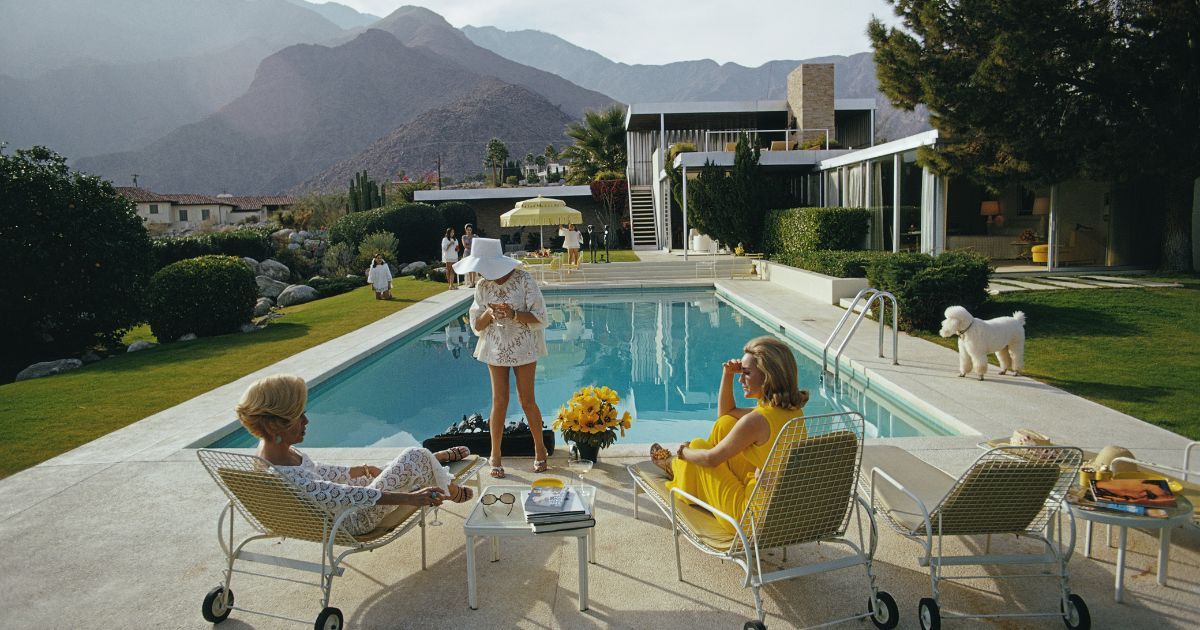
‘Indoor Games’. Women play a board game in a house on Saint Barthelemy in the Caribbean, March 1983. Photo by Slim Aarons.
(Image credit: Slim Aarons/Hulton Archive via Getty Images)
At first glance, analogue rooms seem like a specific kind of solution: architectural, aesthetic, and, not incidentally, expensive. Disconnection, once a luxury afforded to all, is now something to be designed for and, increasingly, something to be afforded. But the desire to disconnect is less niche than it seems, even if a dedicated tech-free space is the reserve of those with not only the finances to fund it, but also the square footage.
Article continues below
Modern life has become defined by a persistent state of over-saturation: late-night scrolling, half-finished conversations, the feeling of being always available. A recent study by Simba found that we’re regularly engaging in habits that disrupt our REM sleep — the phase essential for memory, emotional processing, and mental clarity — leaving many of us technically rested but mentally depleted. Part of the problem isn’t just that we’re busy; it’s that we’re rarely, if ever, offline.
The appeal of analogue is easy to understand. Collectively, we’re craving bygone eras we’ve mythologised as simpler times. This plays out in our appetite for 90s nostalgia — most recently seen through the frenzy over the CBK and JFK Jr show — as well as the resurgence of traditional arts and crafts and the rise of listening bars.

Bambi is described as “a music led restaurant in London Fields”
(Image credit: Bambi)
At Bambi in London Fields, owner James Dye describes vinyl as an antidote to the endless, frictionless scroll of streaming. Records, he explains, impose limits: you have to choose one, play it through, flip it over. “It offers boundaries,” he says, along with a sense of permanence that digital music struggles to replicate. That structure extends into the room itself. The DJs he books have often spent decades building their collections, records not only sourced over years but hauled from space to space. “They’ve spent 10, 15 or 20 years digging,” he says, and the result is a sound that feels deliberate rather than algorithmic. Over the course of an evening, that becomes part of the experience: music opens gently over dinner and builds as tables are cleared and the room shifts into something looser and louder.
The promise, as Dye puts it, is a few hours away from “the humdrum of phones and constant notifications.” A short distance away, The Glendronach Listening Bar experience — a month-long residency at Equal Parts — offers its own version of that escape. “We wanted to create an immersive experience that encourages people to pause, be present, and engage all their senses,” says Glendronach’s Dr Rachel Barrie.
For Michael Sager, the bar’s owner, this reflects a broader shift: a reaction to a decade defined by “speed, optimisation and constant stimulation.” What people are seeking, he suggests, are spaces where “time stretches out a little”.

Paul Firmin, co-founder of Earl of East, has designed an analogue space in his East London home.
(Image credit: Earl of East)
Elsewhere, it looks more modest. On platforms like Pinterest and Etsy, searches for “micro escapes,” memory journals, and traditional crafts are surging, driven in large part by users looking to reclaim experiences that can’t be swiped away.
As Paul Firmin, co-founder of Earl of East, puts it, such rituals “act as anchors” in a culture of endless scrolling, helping people reconnect with themselves and their surroundings.
Caroline Milns of Zulufish reports a growing demand for spaces explicitly designated for offline activity. Other designers describe similar adjustments: living rooms are being reoriented away from televisions, with seating arranged to encourage conversation rather than passive viewing. Screens, if they stay, are hidden within cabinetry or disguised as artworks.
The goal is not necessarily to eliminate technology, but to manage its visibility; to restore, at least on appearance, a sense of balance. There is something faintly absurd in all this; the idea that simply being present requires such elaborate staging, but there’s no denying that these environments are appealing.
Whether it’s a bespoke-designed analogue room or lighting a candle at the end of the day and listening to a record all the way through, the budgets differ, but the desire is the same: to step outside the flow.
The question is whether that feeling can be meaningfully achieved through objects and environments alone. A phone can be put in another room, a record can be played from start to finish, but the same systems of work, communication, and expectation remain largely intact. The risk, then, is that analogue living becomes less a form of resistance than a kind of aesthetic buffer: a way of softening the edges of a life that is otherwise unchanged.
Back at Bambi, the record comes to an end. There is a brief pause before the next one begins, and for a moment, diners resist the urge to check their phone.
We haven’t exactly logged off, but we’re learning to simulate what it might feel like.