

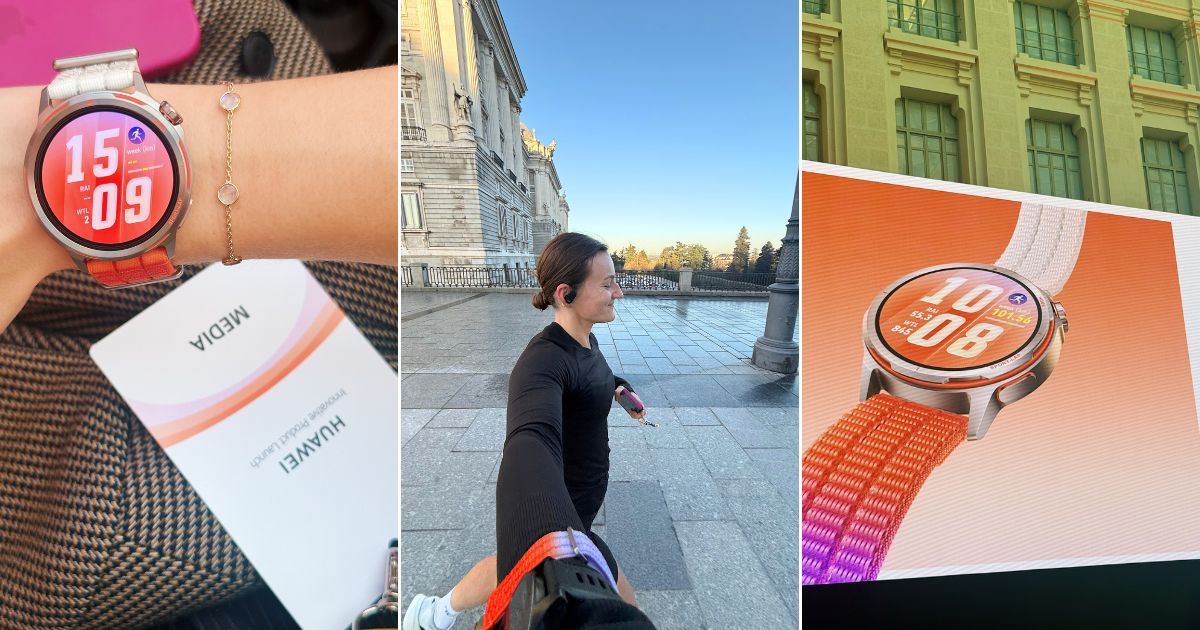
When it comes to fitness trackers, it’s surprisingly hard to design a real all-rounder that offers in-depth enough stats, but also an easy-to-navigate interface that makes incorporating movement into your day-to-day more manageable.
That’s why when I heard that Huaewi had launched their new GT Runner 2, an ultra-precise, GPS-backed fitness tracker, I couldn’t wait to try.
As a runner, my interest was immediately piqued when I heard the watch had been designed by Eliud Kipchoge and team. It’s fair to say that the world’s fastest marathoner, two-time Olympic champion, and the only human ever to run a sub-2-hour marathon, should know a thing or two about what makes a good running watch, and I was eager to see what features he’d incorporated into the design.
Speaking at a press conference in Madrid on the launch, he said, “As an elite runner, the first thing you need to be able to see is your pace. On the GT Runner 2, you can see your pace on the interface as you’re running, and it’ll also predict your 5k, 10k, half-marathon and marathon times based on your runs logged. It’ll also tell you other important metrics, like if your heart rate is high – it works with your body.”
“The predictions are shockingly accurate – the watch can coach you.”
Sharing his desire to make more advanced tracker technology available to the masses, he reflected on how running is for everyone and how tech should make movement easy, which is exactly what this watch aims to do.
For my full Huawei GT Runner 2 review, keep scrolling. And be sure to check out our guides to the best fitness trackers and the best FitBits, while you’re at it.
What is the Huaewei GT Runner 2?
The latest fitness tracker launch from Huawei, and their most advanced running watch to date, the GT Runner 2 has been in the making for years. Incorporating a “TruSense” heart rate sensor, built-in route design capabilities, and a redesigned 3D antenna array for best-in-class location accuracy in one elevated design, it’s got a lot to offer.
With a touch screen and physical buttons to navigate around the in-watch apps, it also seamlessly syncs to your calendar, calls, and banking, meaning you can pay on-the-go with the tap of your watch.
What I liked about the GT Runner 2
I’ve been testing the GT Runner 2 for two weeks now, and honestly? It’s hard to fault. The design is elevated, the usability intuitive, and the data spot on (I wore my Garmin alongside it for many runs and workouts, and most of the data came back near identical). I tested on runs, strength training workouts, Pilates, and walks, and found it easy to use for all types of movement.
As someone who values style as much as substance (what can I say? I like a watch that looks nice), I was immediately drawn to the orange, purple and pink ombre design of the Dawn Orange colourway. I love that the strap colourways match the watch interface, too, although fear not – if orange isn’t for you, there are three colourways available in total (Midnight Black and Dusk Blue). They’re all as striking as the next, and you can tell that the design team have poured a lot of energy into making the watch lightweight, aesthetically pleasing, and something that won’t clash with your day wear.
It doesn’t compromise on functionality, either – it’s comfortable, thoughtfully designed, and surprisingly accurate, with an impressive in-built GPS system and navigation capabilities that the team are claiming are “better than Garmin.”
After two full weeks of testing, I’m still yet to need to charge it – surprising, given I workout most days and have been tapping around on the watch to snoop through its various functions. And on that note, the interface is surprisingly simple to navigate – after around ten minutes or so of figuring out where everything is, I feel I’ve got the hang of starting workouts, checking my steps and stress levels, and even using more advanced features, like the emotional well-being check-in and pulse-wave arrhythmia analysis.
I like the movement prompts that it sends you throughout the day – particularly helpful for when I’ve been sitting at my desk for too long, or when I’m in an editing hole that’s distracted me from any movement in a while. It’s also pretty good at noticing when you’re moving but have forgotten to start your workout, too, buzzing on your arm to ask if you’d like to start recording your session.
I also rate the in-built stress feature and the fact that the watch will prompt you to do some breathing exercises if it notices your heart rate has been raised for a prolonged period of time sans exercise.
One final feature that deserves a special shout-out: The Intelligent Marathon Mode (or “IMM,” as the brand is calling it), a feature spearheaded by Kipchoge and the DSM-Firmenich Pro Running Team. Designed to help you hit a personal best in your next race, it’s essentially an AI-driven “bespoke” plan based on your fitness data from watch collects, and similar to that of Garmin and Coros.

The interface of the GT Runner 2 – aesthetically pleasing but also uber functional.
(Image credit: Ally Head)
What’s not so good about the GT Runner 2?
I’m die hard Garmin user – I’ve had my Forerunner 935 for around ten years now, and have never swayed, I love it that much – so it’d take a lot to convince me to move full-time.
I did feel the GT Runner 2 lacked a tiny bit of depth in regard to its run capabilities. It’s undoubtedly one of the best options on the market if you’re someone who’s mindful of their daily movement, does a range of workouts, and is keen to track steps, standing time, and stress levels. I’d also recommend it for beginner runners or first-time marathoners, as it’s far easier to use than my Garmin and as accurate.
But for marathon runners chasing personal bests who need easy access to the nitty-gritty of their cadence, heart rate, and pacing zones, I found the Garmin interfaces more intuitive and the data more in-depth.
This design, for me, is most similar to an Apple Watch – bright, light, and cheerful, with all the right prompts and reminders – a great all-rounder.

Ally testing the Huawei GT Runner 2 on an easy 6 mile run.
(Image credit: Ally Head)
Is the GT Runner 2 worth the money?
At £350, I think the Huawei GT Runner 2 is well priced. Slap bang in the middle of Coros and Garmin pricing, it’s an investment, but one in your health – and who can argue with that?
It’s also a seriously elevated design, which makes the investment worth it, in my opinion.
Our Editors’ favourite fitness trackers

We’re big fans of the Garmin Venu X1 design. With handy extra features, like a built-in flashlight and LED speaker, GPS mapping, touchscreen capacities, training status insights, and a wildly impressive eight-day charge promise, this is one for athletes and fitness fanatics alike.

Every celebrity and influencer under the sun seems to have an Oura ring – and for good reason. The snazzy, subtle bits of kit are great for tracking your data without wearing a chunky watch or device.
What we thought when testing? “It’s the perfect way to keep track of your health without it being massively intrusive. I particularly enjoyed the sleep scoring and “Readiness” factor (a score that shows you how you might be able to handle the day ahead) and concise weekly reporting. There’s also the option to explore breathwork and guided meditations via the app on your phone.
I have a smartwatch (the Apple Watch SE) that measures my heart activity and sleep too, so it was interesting to see whether the data would match up. I compared the data from my watch (via the Welltory app synced to my phone) and the Oura ring, and for the most part, they gave very similar readings.” – Sunil Makan, Editor

Fitbits are well-loved globally for reliable and easy-to-navigate fitness tracking. While they’re more suited to beginner levels of fitness or those simply looking to track their step count, they’re affordable and reliable.
What we thought when testing: “The Fitbit Versa 4 has been dubbed the most advanced smartwatch from the brand, so as a Health Editor, I was eager to test it out. I trialled my first Fitbit back in 2015 and trained for my first-ever marathon using one. While they’re certainly great at pulling health stats, they weren’t so great on accurate stats and battery life back in the day – which is why I was pleasantly surprised to find that the Versa 4’s stats were similar enough to my much-loved Garmin Forerunner, and the battery life lasted around four to five days.
It looks great, accurately records your health stats, and lasts nearly a week. I’d buy if you exercise a few times a week and love tracking your workout classes and steps.” – Ally Head, Senior Health Editor

Last but by no means least, the screenless WHOOP is a firm favourite among coaches and athletes for its detailed and thorough tracking without the need for a constantly on screen. Rather, the data is all collected on the app on your mobile phone.
What we thought when testing: “WHOOP have long been hailed as the fitness tracker of all fitness trackers, with celebrities and athletes alike swearing by their stats (we’re looking at you, Tom Daley). But it’s slightly different to other competitors. How? Well, it continuously collects data about everything from your recovery to training, to sleep, to stress, versus other wearables that collect data during workouts and shut-eye.
You have to wear it for a few weeks before it starts feeding back your data, but I’ve never had more insight into my overall fitness levels, recovery score, and so on, and it was very accurate when cross-referenced with my Garmin.”