

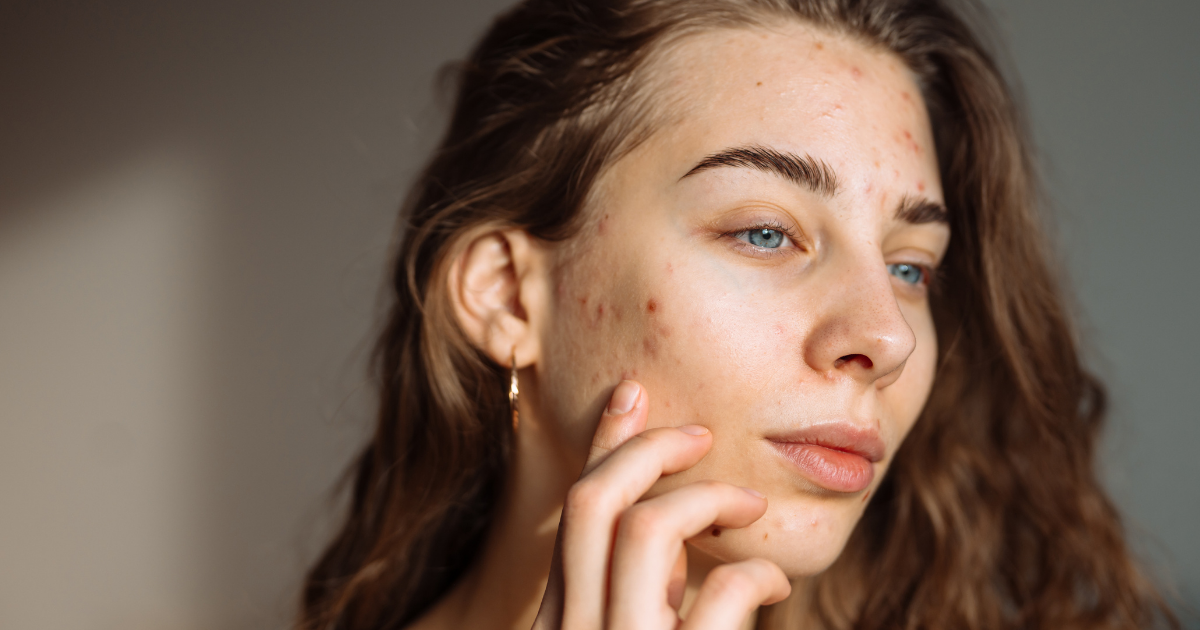
There was a brief, glittering moment when the internet felt honest. When skin looked like skin—textured, hormonal, sun-speckled, lived-in. A time when creators zoomed their cameras closer, not further away, to show the angry cyst they were scared to leave the house with; when brands flung open their casting books and put people with acne, vitiligo, rosacea and eczema (hi, me) on billboards. We were collectively unlearning the shame we’d been taught: that anything other than poreless doll-like perfection made you lazy, dirty, unprofessional, unlovable.
Skin positivity didn’t just soften the harshness of the beauty gaze—it felt like a cultural exhale. For a fleeting moment, texture was allowed to be texture, blemishes could simply exist and we weren’t under the constant pressure to perform “perfect skin.” But as with body positivity—now quietly dissolving under ballet-body nostalgia, the rise of GLP-1s and the suspiciously thinner runways of recent fashion weeks – the movement has been slipping through our fingers. And the real question isn’t how this happened, it’s how it happened so quietly that most of us didn’t notice the rewind at all.
The impact is already showing; Dr Anjali Mahto, Consultant Dermatologist, Laser Specialist and Founder of Self London has seen this shift first-hand. “I’m seeing increasing anxiety, especially in younger people, around how their skin looks,” she tells me – a rise she links directly to the hyper-perfect imagery saturating their feeds. Research from Roseway Labs found that 93% of Gen Z say online beauty standards make them feel worse about their skin, while more than half (53%) say their skin condition makes them feel self-conscious. For other generations, it’s a return to the pressure they felt growing up. Research from Dove found that 2 in 5 Millennial women say early 2000s beauty culture negatively impacted how they see their own appearance, to this day. As someone who lived through that era, the retreat of skin positivity feels like watching the clock spin backwards, straight into a time that felt suffocating, shame-filled and impossibly rigid.
The real impact of tech…
So what’s pushed us to rewind time on embracing our skin as it is? There’s no denying that the shifts in technology have reshaped how we see our skin. Algorithms aren’t neutral—they reward a very specific kind of beauty. Every filter that smooths texture, perfects tone or lightens complexions quietly reinforces beauty ideals that are rooted in Eurocentric ideals. And the payoff for complying is obvious: more visibility, more engagement, more followers. The closer you look to the algorithm’s ideal, the more culturally valuable you become.
As Hallinan and Striphas eerily predicted back in 2016, the AI-driven presentation of beauty has created a kind of “algorithmic aesthetic”: a dominant standard co-produced by code, metrics and platform logic. Everything we’ve seen in the last decade—from the airbrushing tools in the palms of our hands to beauty products that mimic filters—has become a part of our Black Mirror-esque norm. When skin positivity tried to rally against it, that only worked for a while, until we experienced the quiet return to perfectionism. As Dr Mahto notes; “There is a fatigue element: it is difficult to sustain that vulnerability online, especially when people face criticism for it. The movement was important, but it was never fully supported by the platforms that profit from idealised aesthetics.”
‘Glass skin’ or nothing
“These aesthetics are presented as effortless but often require products, procedures, time and privileged access to achieve,” Dr Mahto says. “What appears trend-driven becomes another benchmark people feel they must meet. The goalposts have simply shifted from ‘flawless’ to ‘luminous and poreless’,” she adds. Suddenly, anything less than mannequin-smooth skin feels like failure.
At one end of the spectrum this hits those who are older due to the very nature of younger skin having more collagen and looking more plump, and reflective naturally. On the other hand, because beauty targets a younger consumer every year, now even children aren’t exempt. K-beauty sheet masks might be a decent dry-skin cure for adults, but do kids really need them? Enter the Rini face mask: a celebrity-created hydrogel sheet mask for children aged four and up, marketed as ‘where skincare meets play’.
On the surface it’s a harmless mini-me moment, but underneath is something darker: the pressure to “fix” imagined imperfections before a child can even write their name. Under the guise of copycat behaviour and novelty we’re quietly folding children into the same beauty pipeline that traps women – turning little girls into pre-teens and pre-teens into consumers long before they’re ready. It’s hard to call a sheet mask sinister, but zoom out and it becomes part of a bigger pattern: the shrinking age of beauty entry, the push to “maintain” earlier and earlier and the way adult anxieties about perfect skin are now being handed down like heirlooms.
Just so we’re clear on whether they’re necessary or not: “Children’s skin is thinner, more sensitive and does not need active ingredients or complex routines,” Dr Mahto warns. “Overuse can disrupt the barrier and trigger irritation or long-term sensitisation. The psychological impact is just as concerning – teaching a child that their skin must be ‘optimised’ sets up a lifetime of scrutiny and comparison. Healthy habits matter, but a child’s value should never hinge on the condition of their skin.”
Is perfect skin the benchmark of conservative beauty?
Social media has become a conveyor belt of aesthetics—“clean girl,” “glazed doughnut,” “jelly skin”—a seemingly harmless game of marketable beauty catchphrases. But every trend shares the same underlying brief: be poreless, even-toned, dewy, thin and preferably, very young, preferably white. Even the offshoots – like the trad-wife-coded obsession with tallow balms – nod toward a conservative beauty ideal built on purity, control and a retro version of femininity dressed up as wellness.
Spend long enough in these spaces and your sense of reality dissolves. Filters become the default, creators look unrecognisable in person and the radical skin-positivity communities that once flourished—where people shared eczema flare-ups, hyperpigmentation, rosacea, steroid-withdrawal journeys—have been quietly pushed to the algorithmic fringes. I’ve seen it everywhere; beauty brands quietly drifting back to safe, smooth-skinned casting. Influencers who once showed their acne are returning to soft-focus content. Even the language has shifted—back to “refined,” “corrected,” “perfected” rather than “raw”, “natural” and “textured.”
And we can’t ignore the ripple effect of the DEI rollback and conservative influence that’s happening in beauty right now. It’s damaging to anyone who doesn’t fit the narrow remit of conservative beauty—youthful, ‘natural-looking’ even if there’s a lot of prep behind the scenes, white or light-skinned and of course, thin bodies.
For women of colour, this has real consequences. Dark skin is the focus for correction- evening our skintone and brightening—to get it as close to the Eurocentric standard of porcelain skin as possible. Conditions like hyperpigmentation, acne, rosacea, scarring and eczema can behave differently in melanin-rich skin, yet representation is shrinking precisely when it’s most needed. Dr Mahto says, “Pigmentation variation is normal, yet women of colour have often only been shown in perfected, even-toned imagery. Without representation, common concerns become pathologised and people feel something is wrong with them.”
The future of skin
When I ask Dr Mahto what she’d say to anyone feeling overwhelmed by the pressure to have perfect skin, her answer is grounding but urgent. “Remember that skin is a living organ, not a static image. It will have texture, movement, pores and fluctuations over time. Try to limit exposure to the most curated corners of social media and follow accounts that show a more realistic range of skin. Your skin should not be your defining factor.”
So should we really be surprised by the decline of skin positivity? Probably not. But we should be alarmed by what its disappearance reveals: that unless we’re careful to police our content and delve deeper into what’s keeping us stuck, looking at every perceived flaw in the mirror, or comparing ourselves to those with perfect skin online, beauty standards will always define us. Every decade, they just rebrand and return looking shinier, sleeker and easier to detect than before.
The question now isn’t whether perfection comes back – it always does, and it’s here right now. The question is whether we let it dictate our worth, or finally choose to see – and honour – the skin we actually live in.
Anita Bhagwandas is the author of Ugly: Why the world became beauty-obsessed and how to break free and The Powder Room substack, exploring beauty culture.