

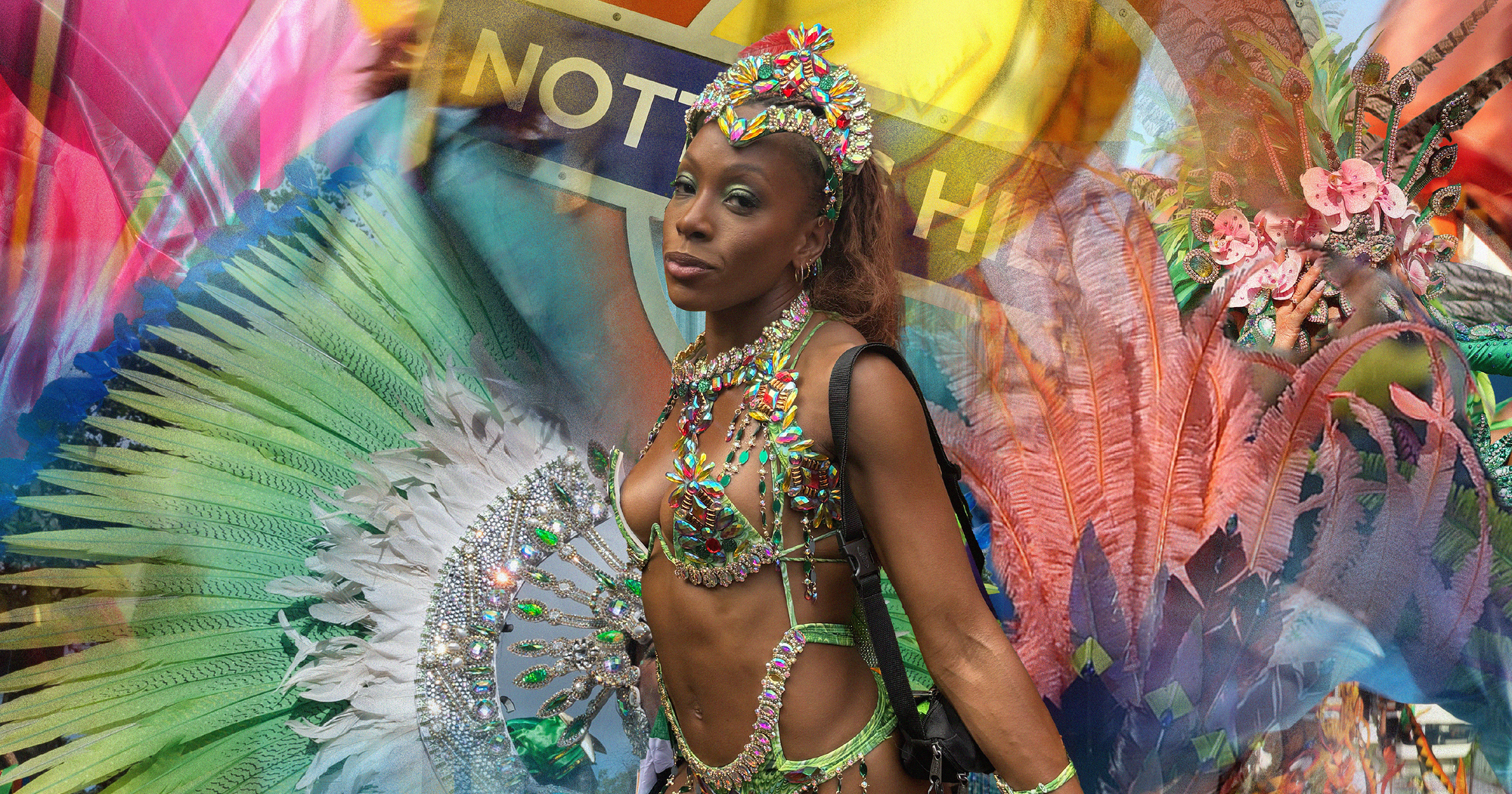
Without Carnival, I wouldn’t exist – literally. My parents met at Notting Hill Carnival in 1994. “I think it was at the Jungle sound system on Tavistock Road,” my mum tells me over the phone. Two years later, I was born and would regularly return to the road with them. As a child, I’d ride on my dad’s shoulders, weaving through the compact crowds, passing all the glamorous masqueraders to meet his friends at the sound systems. More than anything, I wanted to be one of those beautiful women in their dazzling costumes, proudly flaunting their perfect brown skin and wonderful bodies. I could stand and watch them pass for hours, but my parents were insistent on spending the day at the sound systems.
Notting Hill Carnival, 1994, the year Chanté’s parents met
(Image credit: Steve Eason/Hulton Archive via Getty Images)
During my teenage years, when partying with my parents lost its appeal, I started going with friends and discovered so much more. I had the freedom to roam, meet new people, try foods from different islands, and allow myself to be pulled in by the floats that sang to me. Last year, for the first time, I was one of those beautiful girls in bejewelled costumes, dancing behind the ropes as people admired the craftsmanship of my costume.
Participating in Notting Hill Carnival is an entirely different experience from just spectating. You are part of a show, part of someone’s carnival memory; you are the colour that makes the day special, and once you’ve done it, it is impossible to skip out on again.

Chanté Joseph at Notting Hill Carnival
(Image credit: Chanté Joseph)
Earlier this week, I headed to Porchester Hall, where 70 years ago, my Caribbean elders attended Carnival dances. These events were organised by promoters who hired bands and partied into the night, bringing a slice of joy to the Caribbean community during an otherwise difficult time. Though their events were often shut down or raided by police, the defiance of their spirit kept them returning – and here I am now.
When I arrive at the venue, I enter a small room where Hype Mas, a Carnival Band, is distributing costumes to excited attendees. I pick up my jewelled rose quartz costume for Monday and a T-shirt for Sunday’s Dutty Mas.

Chanté Joseph at Dutty Mas at Notting Hill Carnival
(Image credit: Chanté Joseph)
Just 20 minutes up the road, on Southam Street, 65 years ago, a murder occurred that would change British society forever and birth the largest street party in Europe – the reason I’m making this journey. “Carni,” as the young have regrettably started to call it, is a three-day celebration of Caribbean culture and identity in West London. The vibrant colours, food, and festivities conceal a more sinister origin, as the late broadcaster and activist Darcus Howe reminds us: If there hadn’t been race riots in Notting Hill, I don’t believe we would have had the Notting Hill Carnival. If it weren’t for the murder of Kelso Cochrane, Carnival wouldn’t have happened.
As Howe reminds us, the senseless killing of an Antiguian carpenter and aspiring lawyer led to unrest in West London and a need for deep healing. First came the children’s street fayre, organised by Rhaune Laslett, a local community activist. Then, in 1959, Claudia Jones, a Trinidadian human rights activist, organised the first-ever BBC-broadcast indoor Caribbean Carnival. Jones’ event then spread across London in the 1960s before taking to the streets in 1966 and becoming the celebration we all know and love today.

Notting Hill Carnival, August 30th 1977.
(Image credit: Malcolm Clarke/Keystone/Hulton Archive via Getty Images)
Carnival has never been able to exist freely. Talk of its cancellation has been ongoing since the start. In a 1979 interview on Thames at Six, Howe was asked about this very issue. His response: “Unless they show the rest of the world that they’re vindictive, corrupt, anti-black, and pro-colonial in 1979 – unless they show that – there’s no way they can stop Carnival when half a million people want it, and thousands are willing to take part.”
Each year, the focus shifts to the arrests and crimes. It’s one of the few events where police crime statistics are released right away. But despite 2019 findings from Statista and HuffPo showing that arrest rates at Notting Hill over three years are almost identical to those at Glastonbury when the number of people attending is taken into account, media outlets continue to run fear-mongering headlines that misrepresent the spirit of Carnival. This only serves to strengthen the call to shut it down.
Then there’s the pervasive impact of gentrification. With Caribbean migrants selling the homes they once owned in Notting Hill and being replaced with non-Caribbean implants, the existence of Carnival became a nuisance to residents rather than a moment of unity. Their calls to axe Carnival grow louder every year – they feel harder to ignore.

Notting Hill Carnival, 2024, many feared it would be the festival’s last year
(Image credit: Alishia Abodunde via Getty Images)
This year felt markedly different; a leaked letter from Carnival chair Ian Comfort stated that failing to secure additional funding “risks compromising public safety and jeopardising the future of the Carnival.” As the Carnival grows year on year, the demand for support increases, but the funding doesn’t keep pace. When the news broke, a sense of fear swirled amongst revellers who anticipate the festival every year. At the last minute, City Hall, the Royal Borough of Kensington & Chelsea, and the City of Westminster provided the funding for the event to proceed.
Worryingly, though, the deputy leader of Kensington & Chelsea Council, Kim Taylor-Smith, stated that the emergency funding it offered would only be for 2025, leaving the 2026 Carnival in an uncertain position. I shudder to think of London without Carnival. The event has been a staple for over half a century and draws in crowds from not only the city but the world.

Every year, Notting Hill Carnival typically attracts over 1 million people, making it the biggest street festival in Europe. The event spans two days (usually the last weekend of August) and draws attendees from all over the world to celebrate Caribbean culture with music, dancing, costumes, and food.
(Image credit: Jack Taylor via Getty Images)
As the Caribbean population in this country ages, younger generations lose their connection with those who first arrived from the islands; we also lose the stories, memories, and culture that kept us connected to our roots. You can see the collective identity crisis happening among younger generations of Caribbean people who are now, according to the latest census, mostly of mixed heritage. There are many ways we’ve failed to preserve our cultural heritage as Black British Caribbean people, and losing Carnival would be a devastating blow.
I hope this Carnival is not my last and that future generations – those who are far removed from Caribbean ancestors – still feel a sense of pride in this event and recognise its importance for years to come.